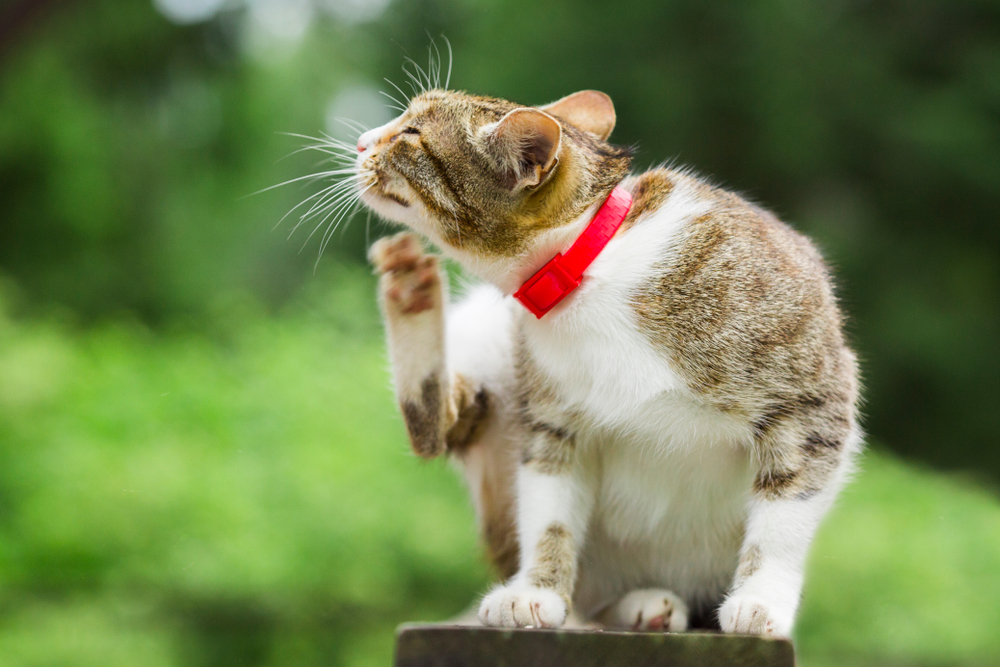
A cat can be itchy for a number of reasons, from allergies to ringworm, mites, hormonal disorders, or skin infections. Allergies are more common than many families think, and they usually trace to one of three things: fleas, a food ingredient, or something in the environment. All three allergic causes look nearly identical on the skin, which is why switching foods on your own or reaching for a store-bought product usually does not settle it. Without an answer, the itching continues, the skin can develop a secondary infection, and your cat stays uncomfortable for months.
Just Cats Clinic in Reston is a certified Cat Friendly, AAHA-accredited, feline-only practice, and itchy skin is one of the more common problems we work up. We rule out parasites, ringworm, and infection first, check bloodwork for hormonal and internal organ health, then read the pattern of hair loss and scabbing to narrow which allergy is at work. That can mean an elimination food trial, environmental allergy testing, and Class IV laser therapy to calm inflammation on raw skin while the underlying cause is treated. If your cat is scratching, overgrooming, or losing fur, reach out to us so we can find out what is driving it.
The Short Course on an Itchy Cat
- Fleas, food, and environmental allergens damage feline skin in nearly identical ways, so the timing of flares and the location of hair loss tell us more than the appearance of the skin itself.
- One flea bite can keep a flea-allergic cat itching for weeks, which is why parasite control for every cat in the home comes before any other step.
- Food allergy is confirmed with a strict eight to twelve week elimination trial, never with a blood test or a store-bought limited ingredient bag.
- Environmental allergy is a lifelong condition we manage rather than cure, and most cats become comfortable once medication, allergen control, and skin care are combined.
What Do Common Cat Itching Symptoms Look Like?
Cats rarely make itching obvious. Rather than scratching where you can watch, most of them overgroom, and a tongue covered in tiny backward-facing barbs strips hair efficiently and almost silently. A few classic patterns of allergic dermatitis, the umbrella term for allergy-driven skin inflammation, show up again and again, and each one has a name:
| What you notice | What it’s called | What it tends to mean |
| Crusty, gritty bumps along the back and neck that you feel before you see them | Miliary dermatitis, named for the millet-seed feel of the tiny scabs | The most common allergic pattern in cats, with flea allergy the top suspect |
| A bald strip on the belly or inner thighs with normal-looking skin underneath | Overgrooming, also called fur mowing, barbering, or self-induced alopecia | Licking driven by itch far more often than by stress alone |
| Scratched-raw sores on the head and neck | Head and neck pruritus, pruritus being the medical word for itch | Classic for food allergy, though any allergy can produce it |
| Firm, raised, red or yellowish sores on the belly, thighs, or lips | Eosinophilic granuloma complex, a family of allergy-driven skin lesions | An immune overreaction that usually traces back to fleas, food, or environment |
Why Do Allergic Cats End Up With Ear and Eye Trouble?
Chronic allergic inflammation makes all skin itchy, including that of the ear canal and along the eyelid margins. An itchy cat rubs against furniture, carpet, and door frames and scratches at the ears, damaging the skin and allowing organisms that normally sit quietly to overgrow and cause a secondary infection.
- Ear flare-ups need a look under the microscope before any medication goes in. Ear cytology, a stained swab of ear debris read under the microscope, separates yeast from bacteria and checks for mites. That is what decides which medication goes into the canal.
- Eyes deserve the same attention. Persistent rubbing of an itchy face can scratch the surface of the eye, and corneal ulcers deepen quickly once that protective outer layer breaks, turning a day of delay into a far more complicated eye.
A cat holding one eye shut needs same-day evaluation for a painful eye rather than an overnight wait. For cats that won’t quit scratching and rubbing their faces and ears, a cone (e-collar) may be needed to protect them.
What Are the Common Causes of Cat Allergies?
There are three main causes of allergies in cats: fleas, food, and the environment. Some cats have very obvious seasonal or itch patterns that help us make a diagnosis right away. Others have more vague symptoms, or allergies to multiple triggers, which makes pinning down the cause more difficult.
| Cause | When it flares | Where it usually shows | What confirms it |
| Flea allergy | Year-round in a heated home, often worst in late summer and fall | Lower back, tail base, belly, hind legs | Response to strict flea control on every cat in the household |
| Food allergy | Year-round, with no seasonal rhythm | Face, ears, neck, paws, belly, sometimes with vomiting or loose stool | An eight to twelve week elimination diet trial, then a diet challenge |
| Environmental allergy | Seasonal at first, often year-round as time passes | Face, ears, paws, armpits, groin | History and exam findings once flea and food causes are excluded |
What Can Make a Cat Itchy Other Than Allergies?
Allergies aren’t the only explanation, so a first visit rules out the imitators and secondary complications of scratching skin raw.
- Skin scrapings look for mites, including Demodex, Notoedres (the mite behind feline mange), and Cheyletiella, better known as walking dandruff.
- A cytology sample from the skin checks for bacteria and yeast overgrowth causing a secondary skin or ear infection.
- A fungal culture checks for ringworm, which might not show the obvious bald patches and circular lesions like it does in humans.
- Bloodwork matters too, since hyperthyroidism (an overactive thyroid) and internal organ disease can change an older cat’s coat and grooming habits.
- A nose-to-tail physical exam and conversation with you helps us rule out other causes of overgrooming, like pain or stress. A cat with arthritis pain may lick a sore joint, or a cat with bladder pain may lick their belly bare, making a thorough exam an important piece of the puzzle.
Several of those imitators are contagious: ringworm and some mites pass between cats and to people, so a second itchy cat in the house, or an itchy person, moves that question to the front of the line.
Can One Flea Bite Really Make My Cat This Itchy?
A single flea bite can drive itching in a flea-allergic cat for days to weeks, because the reaction is to proteins in flea saliva rather than to the bite itself. An itchy cat can carry fleas you’ll never lay eyes on, because grooming strips away the adults and the flea dirt within minutes of a bite. That’s why fleas stay at the top of the list even for cats who never go outside, ahead of food and environmental allergens.
What Flea Allergy Dermatitis Looks Like on a Cat
Flea allergy dermatitis concentrates its damage over the lower back, the tail base, the belly, and the hind legs. Families usually notice thinning fur there first, along with the gritty miliary dermatitis scabs from the table above running down the spine. Skin that stays inflamed for weeks invites bacterial infection and yeast overgrowth on top of the original problem, and at that point the cat is itching for two reasons instead of one. Catching it early keeps the treatment simple.
How We Break the Flea Cycle
Fleas run their entire life cycle indoors straight through a Northern Virginia winter, which is why year-round parasite prevention goes on every cat in the household and not only the one who’s scratching. The home needs attention as well, since eggs and pupae sitting in carpet and upholstery keep hatching for weeks after the adults are gone. Frequent vacuuming and hot-cycle laundering shorten that window considerably.
Which product fits depends on your cat’s age, weight, and other health conditions, one reason preventive exams and annual lab work stay on the calendar even for a cat who never goes outside. Never apply a flea product labeled for dogs to a cat. Permethrin-based topicals are a common cause of seizures and death in cats, and the exposure can happen just from grooming a treated housemate. If it does happen, wash the product off with liquid dish soap and call us or the Pet Poison Helpline on the way in, since tremors can begin within hours.
How Do Food Allergies Show Up in Cats?
Diet is a real cause of allergies, just a less common one than most families assume. Only a minority of allergic cats are food-responsive, and those cats usually itch year-round rather than in a seasonal pattern, often with vomiting or loose stool alongside the face, ear, and belly irritation.
Food Allergy and Food Sensitivity Aren’t the Same Thing
The protein a cat reacts to is almost always one they’ve eaten happily for months or years, which is the defining pattern of food allergies. Chicken, beef, and fish head the list precisely because they’re in everything. It’s why “we haven’t changed anything” doesn’t rule food out.
A sensitivity is different: it upsets the gut without involving the immune system, and it tends to produce loose stool or vomiting without the skin signs.
How an Elimination Diet Trial Works
Elimination diet trials run eight to twelve weeks on a single prescription diet built around a novel protein your cat has never eaten, or a hydrolyzed one, with protein broken into pieces too small for the immune system to recognize, with no treats, flavored medications, or table food, because one lapse invalidates the result. Over-the-counter limited ingredient formulas can’t settle either question, because many carry trace proteins from shared production lines and none are made to diagnostic standards.
Improvement alone doesn’t close the case. A diet challenge does: the original food is fed again, and if the itching returns within days to a couple of weeks, the diagnosis is confirmed. Multi-cat households need separate feeding stations for the duration, and cats should stay indoors for the whole trial to avoid hunting or eating a snack the neighbor left out, which is usually the hardest part of the plan.
What Sets Off Environmental Allergies in Cats?
Atopic dermatitis is an inherited tendency to overreact to ordinary airborne particles: tree and grass pollen, dust mites, mold spores, and dander. Signs typically begin between one and three years of age. Cats show it mostly in the skin, with itching around the face, ears, paws, armpits, and groin rather than the sneezing a person would have. The same airborne allergens can inflame the airways too, and feline asthma and bronchitis sometimes travels alongside allergic skin disease, so mention any coughing or wheezing at the visit.
Living indoors doesn’t protect a cat here. Dust mites and indoor molds are present all twelve months, and pollen rides in on clothing and open windows. Northern Virginia stacks tree pollen in spring, grass in summer, and ragweed into the fall, so a cat who started with one bad month often creeps toward year-round signs as sensitivities accumulate.
Can Allergy Testing Help My Itchy Cat?
Allergy testing and immunotherapy helps a great number of cats. Atopic dermatitis is identified by ruling out parasites and food allergies first. What allergen-specific testing does is choose the extracts that go into sublingual immunotherapy, allergy drops given under the tongue, or allergy injections once flea and food causes have been ruled out. Skipping to a test at the start produces a list of positives that may have nothing to do with why your cat is uncomfortable, so we take the steps in order instead.
What Actually Stops the Itching?
Relief comes from two tracks running at once: reducing exposure to the trigger, and quieting the immune signaling that carries the itch. Most allergic cats need both, plus treatment for whatever infection has moved in. Management is the goal rather than cure, and a comfortable cat with a full coat is a realistic one.
- Itch-targeted medication: JAK-Kinase inhibitors like Apoquel block the chemical messengers that carry the itch signal rather than blunting the whole immune system the way steroids do. In cats it’s prescribed off-label, with dosing and bloodwork monitoring adjusted for cats. Cyclosporine, an immune-calming liquid or capsule licensed for feline allergic skin disease, works well too, though it needs four to six weeks to reach full effect.
- Short-term anti-inflammatories: Steroids remain useful for breaking a severe flare quickly, given at the lowest effective dose for the shortest time, since long courses raise diabetes risk in cats.
- Infection control: Secondary bacterial and yeast infections are treated on their own merits, guided by cytology, because an infected cat keeps itching no matter how good the allergy plan is.
- Topical therapies: Medicated mousses, sprays, and wipes put topical therapy directly on inflamed skin, lowering surface bacteria and yeast and adding itch control while systemic medication takes hold.
- Long-game desensitization: Immunotherapy retrains the immune response to specific allergens over months and is the closest thing to a durable answer for atopic cats.
- Changes at home: Allergen control at home does real work: laundering bedding weekly, running HEPA filtration, and wiping the coat after any outdoor exposure all cut the pollen, dust mite, and mold sitting against the skin.
- Skin comfort and repair: Omega-3 supplementation improves skin health and lower inflammation when used long term. Our team also uses therapeutic laser treatment on raw, inflamed areas to reduce inflammation and speed healing while the medication works.
Two things are worth avoiding at home. Never give human combination allergy products, since the decongestants and pain relievers blended into them are toxic to cats even in small amounts. And hold off on switching foods before we talk, because a well-meant diet change in week one can cost you an accurate answer in week twelve.
Questions Cat Families Ask Us About Itchy Skin
My Cat Never Goes Outside. Do We Still Need Flea Prevention?
Fleas reach indoor cats regularly. They ride in on shoes and pant cuffs, arrive with a visiting dog, hitch along with a new cat, and travel with the mice and squirrels that get into garages and attics. For a flea-allergic cat, one bite is enough to start weeks of misery. Consistent prevention takes most of that risk off the table for a modest monthly effort.

How Long Until We Know Whether the Plan Is Working?
Each part of the workup runs on its own clock, which is worth knowing up front so nobody gives up early. Strict flea control needs four to eight weeks before its effect is clear. A diet trial takes the full eight to twelve weeks plus the challenge. Anti-itch medication often helps within days, cyclosporine takes about a month, and immunotherapy is judged over six to twelve months. We check in along the way and adjust rather than waiting silently for the finish line.
Could My Cat Be Overgrooming From Stress Instead?
Behavioral overgrooming is real, but it gets blamed far more often than it deserves, and treating a medical itch as anxiety wastes months. We look for a medical cause first, and stress is considered once parasites, infection, food, and environmental allergy have been addressed. Sometimes both are in play, since chronic discomfort makes a cat more reactive to household change. If your cat has chewed an area raw or won’t settle long enough to eat, our team runs urgent care on weekday evenings and weekend afternoons for exactly that kind of problem.
Getting Ahead of the Itch at Just Cats Clinic
Watching your cat pull out their own fur is hard, especially without knowing why. Working through fleas, then food, then environment in that order is what turns guesswork into an answer, and the large majority of cats end up comfortable once we find the driver. Just Cats Clinic sees this pattern every week in Reston, and we’d much rather start while the skin is still intact than after weeks of scratching have opened it up.
If your cat is scratching, licking bald patches, or shaking their head, reach out at the first sign of itching while the pattern is still easy to read.